
中国繁育最美蛇
China's earliest tinned iron armor found in Zhejiang: 1,700-year-old anti-rust tech revealed_我的网站

A |
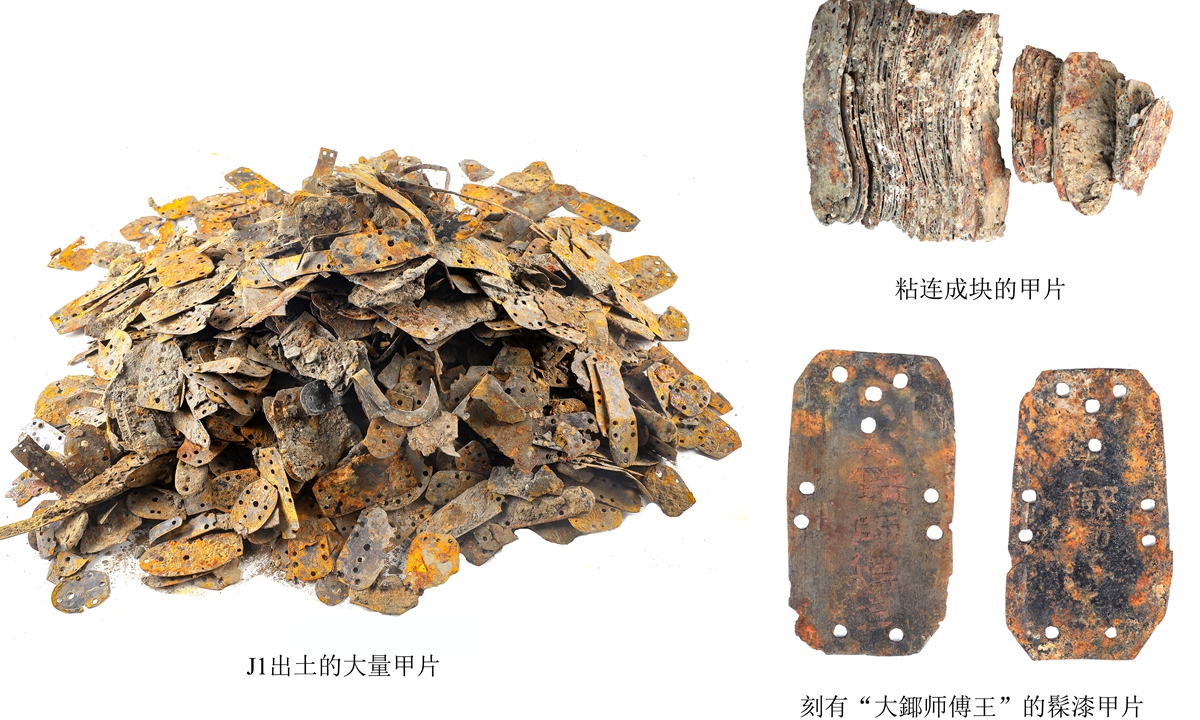
While China has a long history of making tinned bronze and tinware, there has long been a lack of reliable historical records or physical evidence to prove early local production of tinned iron artifacts. The newly discovered armor plates can fill this gap, demonstrating that, by no later than the Wu period, local craftspeople in Zhejiang Province had mastered the art of tin-plating iron surfaces. This reflects the region's advanced metallurgical skills at that time, Ge Shuaikun, a researcher at the Shaoxing Institute of Cultural Relics and Archaeology, told the Global Times on Tuesday.
Over the last three years, archaeologists working at the Jizhong ruins site have excavated hundreds of tinned iron armor plates from ancient wells and ash pits. A preliminary investigation confirmed that the surfaces of these plates contain high levels of tin. Subsequent laboratory analyses were conducted in collaboration with the Shaoxing's institute and the Institute for Cultural Heritage and History of Science & Technology at the University of Science and Technology Beijing with methods such as Scanning Electron Microscopy with Energy Dispersive Spectroscopy (SEM-EDS), X-ray Diffraction (XRD), and Micro-CT to deeply examine the samples' materials, structures, and technological traces.
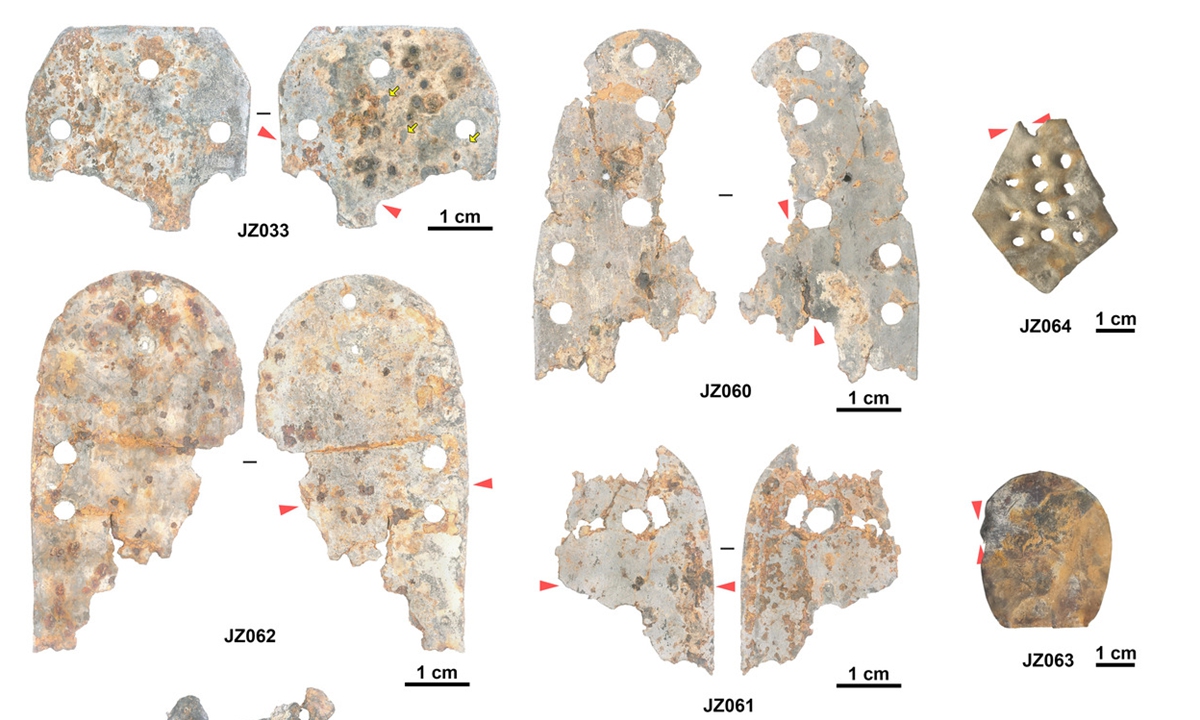
Research shows that the craftspeople immersed iron armor plates in molten tin, thus ensuring complete coverage of the surface with a continuous tinned layer. This coating isolated the iron from exposure to air and moisture, dramatically boosting corrosion resistance. Many of the excavated tinned armor pieces still show a clear, bright silver-white finish.
One major reason for tin-plating the armor was to prevent rust. At the same time, the silvery white shine of tinned iron offered a more striking, beautiful appearance, standing out from the typical dark iron armor of the era. This visual distinction may have marked these pieces as a higher-grade military asset, according to an article from the University of Science and Technology Beijing's official website.
The article said that in earlier eras, from the pre-Qin to Han dynasties, tin was widely used as a surface coating on bronzeware and ceramics. Researchers believe the tin-plating of iron armor discovered at the Jizhong ruins site during the Wu period of Three Kingdoms built upon this local tin-coating tradition, representing an adaptation of those techniques across different materials. The process likely benefited from technological exchange among various specialized workshops at the site, including those making bronze castings, iron weapons, and other metallurgical products.
。 华硕ROG雷切2 PRO无线手柄现已在电商平台正式上架并开启预约,新品定位高端,定价1299元,将于8月28日正式发售。 这款手柄最吸睛的设计在于正面配备了一块全彩显示屏,玩家可直接在手柄上调整配置文件、RGB灯效、按键映射等设置,甚至能够播放自定义动画,省去了依赖电脑驱动或手机应用的繁琐步骤。性能方面,该手柄支持8K轮询率,官方宣称可带来更低的输入延迟,满足竞技级玩家对响应速度的苛刻要求。操控配置上,雷切2 PRO采用TMR传感器驱动的摇杆,支持热插拔设计,玩家可根据个人习惯更换高矮两种摇杆帽,既解决了摇杆漂移的痛点,也延长了手柄的使用寿命。方向键、ABXY按键均采用微动开关,触发更干脆、响应更迅速。扳机键支持双模调节,可在短行程微动与全行程TMR传感器之间切换,以适应射击、赛车等不同类型游戏的操作需求。

B | 此外,手柄背面和顶部还设有额外肩键与可拆卸背部按键,进一步拓展了自定义空间。连接与续航方面,该手柄支持蓝牙、2.4GHz无线及有线三种连接模式,兼容PC平台。

C | 官方数据显示,在关闭屏幕、振动和RGB灯效、轮询率设为1000Hz的条件下,2.4GHz无线模式续航可达79小时,并附带底座充电功能,随包装还配有便携保护充电盒、摇杆模组拆卸工具等配件。本文由游民星空制作发布,未经允许禁止转载。
Current article:http://pcm3.wenwancaomohenenqiongpangshun.bond/x4iuyr/6wir2w7.html
Published on:19:46:34